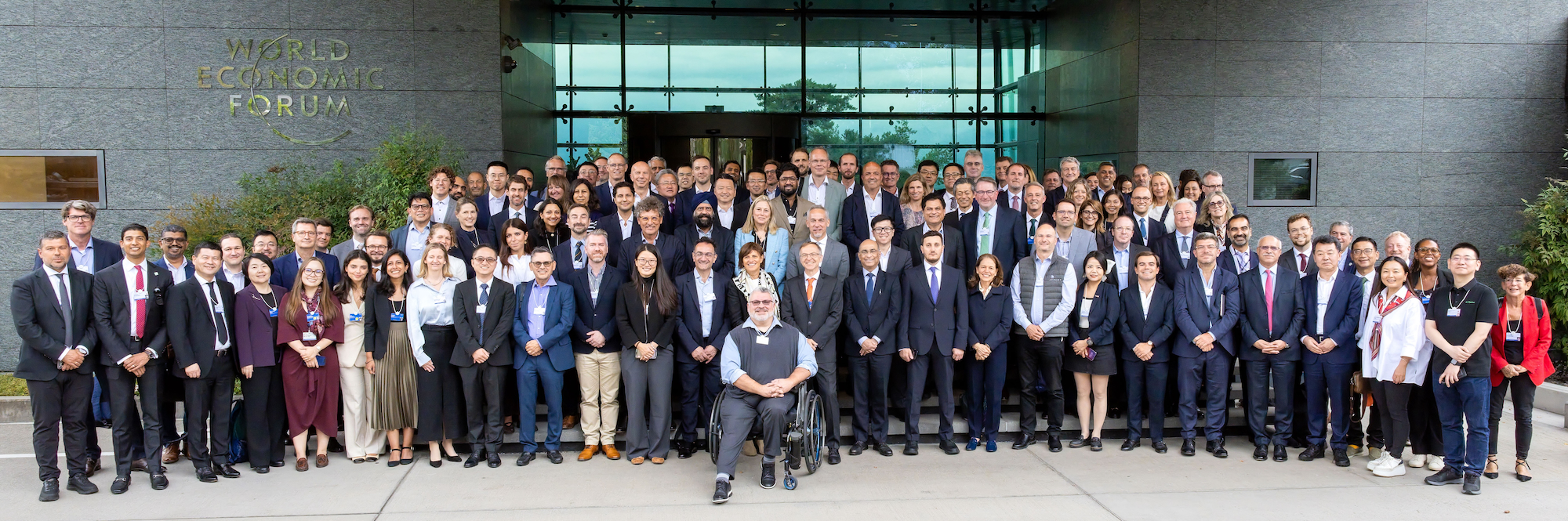
The World Economic Forum (WEF) convened the Energy Forum 2026 in Geneva on September 15–16, under the theme “Solving the New Energy Equation.” More than 170 global leaders, business executives, policymakers, technology innovators, and representatives of international organizations from 34 nations came together to work on solving the world’s biggest problems.
Among the key points Terra Praxis advanced at the Forum:
• Clean fuels. Nuclear energy can support scalable, competitive, refinery-scale production of hydrogen-based synthetic fuels.
• Data centers. New developments must understand and address the drivers of public opposition, eliminate environmental impacts, and generate meaningful socio-economic benefits for communities. Nuclear energy can pair well with new data centers to provide emissions-free, water-positive, super-dense power generation.
• Coal repowering. Repowering coal and other industrial assets with nuclear preserves jobs and reuses and expands the use of existing assets such as transmission.
Our analysis shows why coal sites are a practical starting point for nuclear energy:
1. Security. Coal and gas are shipped fuels, so a bad month at sea can mean a blackout. Nuclear fuel is a stock: years of it fit in a warehouse, and it is about 5–10% of the cost of electricity. Reducing dependence on imported fuels increases energy security.
2. Cost. India, for example, generates 74.6% of its electricity from coal (215 GW, 754 TWh) and builds some of the least costly nuclear energy in the world. It has completed 700 MWe units at US$1,560–1,830/kW.
3. Reuse. Every coal site already has a high-voltage connection, water rights, a workforce, and a host community. Running those connections at about 90% instead of today’s roughly 64% moves far more energy through wires already built and avoids hundreds of billions in new grid. India prices its transmission program to 2032 at more than US$100 billion. Germany’s equivalent is €651 billion, of which repowering could avoid €300–400 billion.
4. Co-location, jobs, and community. Replacing or adding generation within the existing footprint lets the district keep its jobs, its tax base, and its power. Many of the communities beside these plants see that value and are volunteering to host nuclear energy.
5. Nature and air. Utility solar needs 2–4 hectares per MW, on the order of 60–100 km² per GW of firm-equivalent output. Replacing 215 GW with solar alone would require more than 10,000 km², which may be neither sustainable nor feasible. Concentrating generation on land already industrialized protects nature, and replacing coal with a source that runs at higher output cuts the air pollution whose greatest cost to communities is measured in health and wellbeing, not dollars.
Terra Praxis thanks Roberto Bocca, Member of the Executive Committee and Head of the Centre for Energy and Materials, and Espen Mehlum, Head of Energy, Centre for Energy and Materials, at the World Economic Forum, for inviting us to contribute.